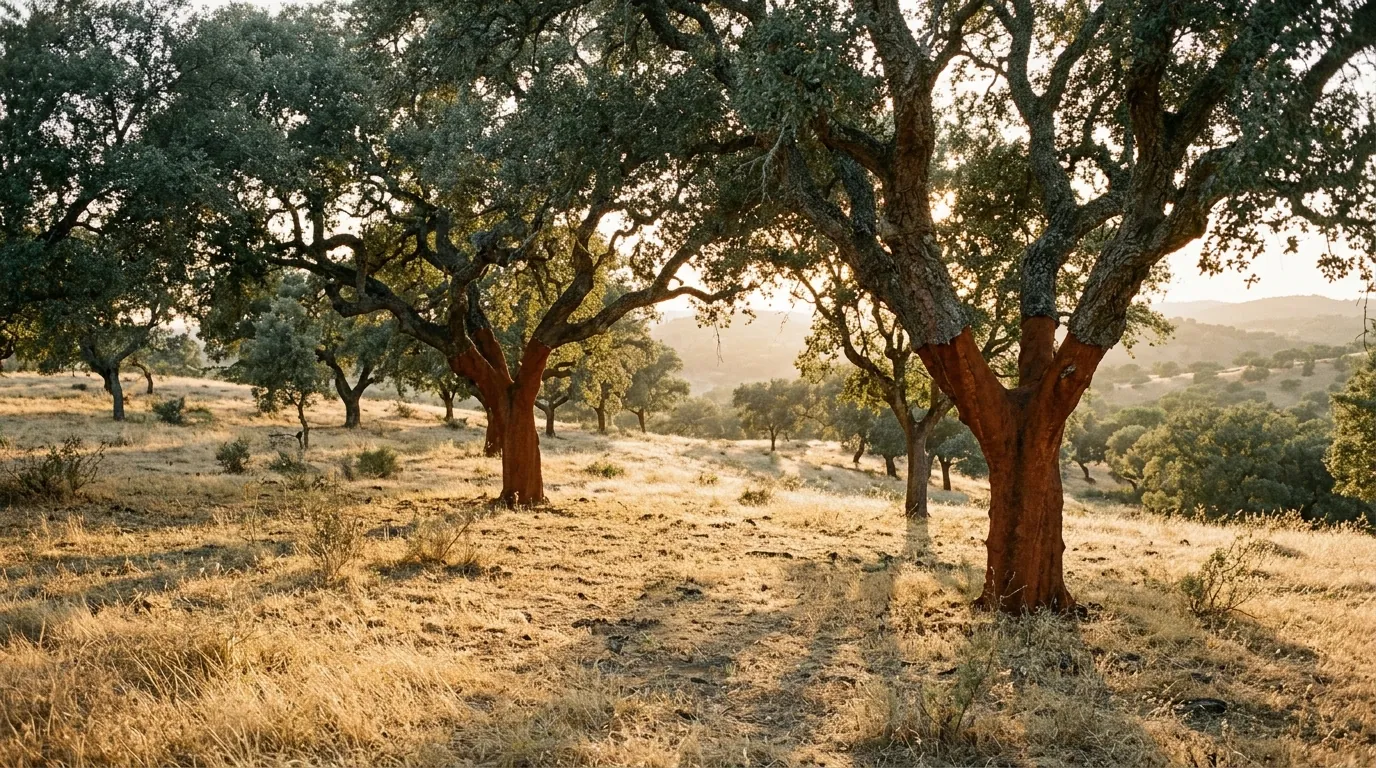
Cork is bark. Not the wood of a tree, and not something we make — it is the outer bark of the cork oak, grown slowly over years and lifted off in one piece. Almost everything else in a workshop arrives as a manufacture. This one arrives as a harvest.
Stripped by hand, and the tree stays standing
The stripping is done by hand, with axes shaped for the work, by people who read each trunk before they touch it: bark comes away cleanly only in the season it is ready to. Nothing is felled. The tree is left standing exactly where it grew, bare and alive, and quietly begins to grow a new layer of bark.
About nine years later that new layer is ready to be stripped again. In many cork forests the last digit of the harvest year is painted on the trunk, so whoever comes next knows which trees are due — a calendar kept on the tree itself, in white paint, for nearly a decade.
Dried, boiled, sliced, bonded to cloth
Once the bark is off the tree it is dried, boiled and flattened, then sliced into thin sheets. Each sheet is bonded to a textile backing, and that is cork fabric: a thin layer of cork bonded to a textile backing. In that form it behaves like cloth — it can be marked, cut, folded, pinned and sewn.
So we cut and sew it with the habits of coat making. Patterns before anything else, edges cut clean rather than torn, seams trimmed and pressed, and closure hardware placed where a hand expects to find it. Every sewn piece carries one straight line of rust-red topstitching, and only one — the Red Line. Plain coasters and placemats are cork sheet, unstitched, with nothing to hide behind. We work in three tones: Natural, a honey tan; Smoked, a dark espresso brown; Moss, a muted olive green.
The grain is never the same twice. Cork is a growth, not a print, so the piece you receive will not look exactly like the image on its page. That is why we put a texture magnifier on the site and why every texture is also shown as a close-up image: a small image cannot hold that much surface, and we would rather you see it before it arrives than be surprised by it afterwards.
What we write, and what we do not claim
Every product page states what the piece is made of: cork fabric, the rust-red woven textile lining inside bags and pouches, and metal zips, snaps, buckles and rings. The exact composition of the textile backing and the lining is confirmed with our supplier for each production batch, so if you want to know what is in the piece you are considering, email us and we will tell you.
We also leave things unsaid when we cannot show them. There is no waterproof or water-resistant claim on any page, no stain-proof claim, no certification marks, no “leather” or “vegan leather”, no country of origin we cannot account for, and no review we cannot show you. Care is simple: wipe with a soft, slightly damp cloth and air-dry away from direct heat and sunlight; do not soak or machine-wash. Coasters and placemats are not trivets — please do not set pans or dishes straight from the oven or stove on them.
That is the whole of it: a tree that gives up its bark and keeps growing, and a workshop that cuts and sews what it produces. Everything we have is in the shop — start with a card holder, or go straight to a bag.